

This blog continues my series about how to get your book self-published. If you haven’t already, you can read Part 1 here and Part 2 here. The aim of following the advice in these blogs is to get your book in the best shape possible, following the traditional publishing house method of having multiple edits, as well as ensuring that you have excellent cover design, interior design and marketing. All of these will make your book look – and be – more professional, encouraging better reviews and sales.
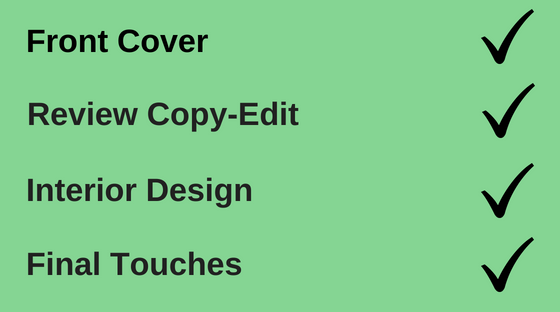
This stage will focus on reviewing some areas of your progress so far, as well as starting to look at the interior design for a print book. We will also be considering writing the final touches, such as the acknowledgements page, a dedication and an author bio (if you don’t already have one).
Choosing Your Front Cover
The first step we will be looking at today is finalising the front cover design. In the last stage, you chose a designer and sent out the creative brief, so now is the time to be looking at the results. Make sure that you are happy with the title, subtitle, tagline, design and art on the cover.
If you are not satisfied, bear in mind you may need to pay the designer more for revisions, particularly if there are a lot. Try to be clear about what you want from the start and make sure you are easily reachable if the designer needs to ask you any questions. A firm, comprehensive brief with discussion can save you both a lot of trouble in the long run!
Also, if you will be publishing a print version of your book, remember that you will need to decide what trim size your book will be and check that the cover still looks good at this size and resolution! This is another point to include in your original brief to the designer, although they will possibly ask anyway.
Reviewing the Copy-Edit
Having sent your work out to be copy-edited, you will need to review the changes that have been made and the comments put forth. You should put aside at least a week or two to resolve all of these issues, depending on the length of your manuscript.
When you get your manuscript back, don’t be surprised if it is now covered in red ink in Word’s Track Changes! This is how nearly every copy-edit will look coming back, but don’t be overwhelmed by it – the majority of changes may be quite minor ones. For example, something as simple as adding a comma will prompt another line to be marked up in red, so reviewing changes like this won’t take long and is unlikely to cause any issues for your manuscript.
Another point to keep in mind is to be open to what your editor is saying – if not, there is not much point in spending money on their services! An editor will try to help you to get your book in the best shape possible to be published, so they will give honest feedback on what needs changing and what could be improved.
A copy-editor will mostly be focused on spelling, grammar, the flow of the text and some minor content and fact-checking, so you will have some idea of what sort of amendments to expect. Like you, they will want to make the best book possible, so you are working together with the same aim.
Try to be reasonably available for any queries the editor might raise during their work, so these can get resolved and the manuscript back to you. Obviously, you don’t need to be instantly available, nor will your editor expect you to be! They will probably save any queries to send in a weekly batch or similar, but if you have a preference for how they handle these, discuss this with them.
Starting the Interior Design
If your book will also be released as a print version, you might want to consider investing in an interior designer for your book. Whether you need one of these depends on how confident you feel doing it yourself – including resolving any issues that come up – and what type of book you are writing.
Text-heavy manuscripts with little or no images or styling, such as novels, may well be possible to design yourself. The lack of styling makes it easy to use a template or simple design you’ve created yourself and still keep the print edition looking professional and polished.
Books that have a lot more design elements and contain things such as pictures, graphs or tables will be more likely to need a professional designer to ensure everything looks smooth and stays the same in different formats or reproductions. A designer will be able to properly format the work in a way which looks good and will easily be uploaded as an ebook.
If you are releasing a print and ebook version of your book, remember that you will need to ensure the text and formatting stays the same in both versions. A professional designer will be able to convert your print version into an ebook style, keeping all of your design elements the same.
How many design elements you have will depend largely on what your book is, as well as what genre. Non-fiction books tend to have much more in the way of photos, diagrams and multi-level headings than fiction books do. Design elements include things like this, as well as the style of chapter headings and other sub-headings, how lists are formatted, how to display a quote and inserting graphs or similar.
Final Touches
Now is the time to consider your acknowledgements page, a dedication and an author bio. You may decide to have all of these, some of them, or none. It’s entirely up to you! An author bio can be a good way to engage with fans, making you seem more personable, whereas an acknowledgements page is a good way to thank anyone who has made your journey that bit easier, maybe by offering their expertise on a subject or purely by supporting you through the process.
Wrapping Up
You’re now well on your way to self-published author! Keep at it and stop by next time when we will be looking at reviewing your interior design and creating a back cover design and index.
Want help proofreading your work? Contact Carmine Proofreading for a friendly, professional service from a qualified proofreader.
Email: CarmineProofreading@gmail.com
Twitter: https://twitter.com/CarmineProofed

 Carmine Proofreading
5 thoughts on “How to Self-Publish Your Book, Stage 3 – Resolving Issues and Interior Design”