

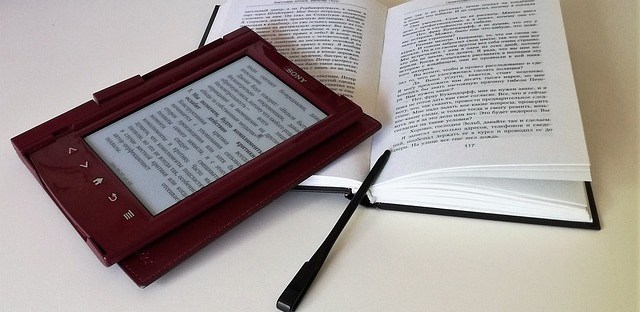
In the previous instalments of this series, we looked at the advantages and disadvantages of having a print version of your book. This time, we will be considering what the advantages of having an ebook are and whether you need a print version as well. Ultimately, it will depend on what you want and what feels right for your manuscript.
One factor that will influence whether you should have a print version is what genre and category your book is. If it is a non-fiction book about a topic which includes a lot of pictures, diagrams and tables, it may be better to have a print version available as many people prefer to or find it easier to look at these in print.
On the other hand, if you have written a fiction, text-heavy book, for example, a detective novel, it may not really need a print version. There won’t be any issues with images because there won’t be any – or if there are, they are few and far between. Just having an ebook of this is most likely fine and people can pick it up and read it whenever.
Of course, there are many advantages to ebooks in general that print books don’t have. For example, you don’t need to worry about what font size to choose – readers can set this themselves, at whatever is comfortable for them.
This can also mean that your book is accessible to a wider range of people in general. Partially sighted people can increase font size to make it readable and blind ones may be able to use a text-to-speech system to allow them to hear the book, which isn’t possible with a print version. This sort of technology can also be useful to people with dyslexia, for example.
Another advantage of ebooks over print is that they don’t take up any extra physical space on a shelf. In addition, they are more portable, with e-readers being available for phones and tablets, which can be great for your readers’ commutes or to take on holiday with them. Percentage read can also sync across an ebook account, so they can keep their place, even on a different device.
In terms of self-publishing, just having an ebook is much more cost effective. You won’t have any costs after the initial ones – print books will require a lot of recurring costs, such as storage and distribution, which do not apply to ebooks. You can calculate the cost your ebook a lot more easily, without the varying running expenses for printed books.
Once your ebook is available, there is no limit to the number of copies you can sell. There is no need for another print run if your book sells more copies than expected, with all the extra costs this will produce. Your book is also instantly available to readers, without them having to wait for postage or for more copies to be printed!
Self-publishing just an ebook is also faster than having a printed version as well. While printing can be very quick, it still isn’t a match for uploading it to an online selling platform and just waiting for it to be approved before it is ready for sale. This will depend on how quickly you want your book to be published and whether you have a tight deadline.
It can also be easier to deal with publishing just an ebook. You don’t need to send all the required files to the printer and then arrange for what will happen to all the books – where they will be stored and how they will get to shops or readers. An ebook can just be uploaded to the selling platform and it is ready instantly.
Another key advantage of ebooks is the fact you can update them if you need to make corrections or add in something else. There is no such option with printed books. You could add a correction slip at the start, but this relies on the reader noticing it. This can also only be done with copies you have not yet dispatched – once a reader has bought the book, you can’t do much about it other than issuing corrections online, which they might not see.
Another advantage of ebooks is that they will usually just have a front cover, which will display on the selling platform and on the first page of the ebook. This means that there is no need to design the spine and back cover (or have them designed for you). You may still decide to have a back cover, but this is not a requirement and the lack of one will not be something that is noticed or unusual.
What this means for you, as a self-publishing author, is a lot of time and money saved. If you design the spine and back cover yourself, it will take more time and you will need to make sure that you have them ready in the correct size and quality to upload or send to the printer. There is also the risk that they might look unprofessional if you do not have much experience in the area of designing.
On the other hand, if you have someone design them for you, this obviously means another expense before you can publish your book. You will save time with not needing to personally design it but remember that you will still need to set some time aside to plan what you would like on the back cover and assemble a brief for the designer. You will also then need to review the design with them before you can send it to be printed.
Wrapping Up
I hope that this helps you to understand when it might be a good idea to just have an ebook. Next time, we will be considering the disadvantages of this method of publication, so do come back then!
Want help proofreading your work? Contact Carmine Proofreading for a friendly, professional service from a qualified proofreader.
Email: CarmineProofreading@gmail.com
Twitter: https://twitter.com/CarmineProofed

 Carmine Proofreading
4 thoughts on “Should I Have a Print Version of My Self-Published Book? – Advantages of Ebooks”