

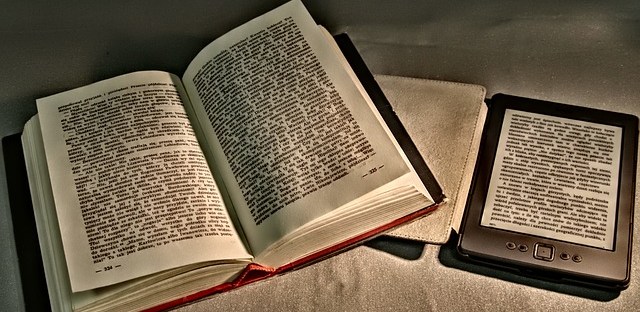
In previous posts, we have looked at the advantages and disadvantages of having a print version of your self-published book, as well as the advantages of just having an ebook. In this final instalment, we will be considering the disadvantages of just having an ebook version of your book and how these may affect you and your manuscript.
You can then take all of these points, as well as the ones from other blogs, into account when making your decision on how to publish your book. This is one of the key advantages of self-publishing – you have the freedom to make choices like this for yourself.
One disadvantage of not having a print copy of your book is that people may not view your ebook as having the same validity as a more traditional print book. Some readers will only buy the book if it is available in a print version, either because they prefer it in this format or because they don’t have an e-reader or e-reading software. This can result in reduced sales, as well as meaning your book is less likely to get recognition and gain traction.
In addition, some reviewers will only consider books that are available in print as well, even if they don’t read it in this format. Reviewers can have a large following whose views and buying choices they influence, so this can mean that you potentially miss out on opportunities for marketing and to gain new readers.
Another disadvantage of only having an ebook is that it reduces the opportunity for other marketing events at local bookshops or talking on a panel, for example. With any of these events, it is a good idea to have physical copies of your book (or books) on hand to sell or give away. It is also easier to sign physical books if you will be doing this at talks or in giveaways. Whilst there is software that allows you to sign ebooks, it is less convenient and still not quite the same!
You may also be ineligible for some marketing opportunities if you only have an ebook. For example, a website or magazine promoting your book may well do this on the condition that they have some physical copies to give away in a competition. If you think you will be marketing in this way, it is best to have a print version as well as an ebook.
Ebooks are also less suitable for some genres of book, for example, a non-fiction book with a lot of diagrams and tables may be easier to read in a print version. Ebooks are not necessarily ideal for looking at these more complicated design elements, although they may be more useful in other ways, such as being able to zoom in on finer details.
It is also easier to compare two graphs, for example, that are on opposite pages of a print book. In an ebook, the reader has to switch back and forth between them; in a print version, they are already there. In addition, if you want to compare details in multiple textbooks or similar, it is simpler to have both open in front of you as print books, rather than having both on the same device as ebooks.
Another format that isn’t really yet suited to ebooks is children’s picture books. While ebooks display pictures perfectly well, the device they are on is rarely as big as the picture book itself would be for the child to look at. In addition, physical books may well be the preference for buyers in this category simply due to the general look and feel of it. Print books also allow the child to help turn the pages or do this themselves when they are older, which isn’t the same with an ebook!
Of course, there is one type of book that doesn’t work at all as an ebook: children’s books with tactile elements. For example, anything with some soft fabric or crinkly foil really has to be published in print to work at all! Presumably, you will already know what your book will need in this sense, though.
Other types of book where a print version is of great benefit are the local ones: local history, folk tales or walking guides. All of these books will be relevant to one particular area, so it makes sense to market most of them to people in that area. A print version makes this much easier than an ebook would.
If you can display your book in local bookstores, this is the ideal place to sell a book that is focused on the surrounding area. Residents and tourists alike can see the book and pick it up if they want to know more about their home or where they are visiting. This is an excellent way to market your exact target audience – readers interested in local knowledge. None of this can really be done with an ebook.
Wrapping Up
Ultimately, whether you decide to have a print version of your book as well as an ebook will come down to a number of factors. These may be your personal views on the different formats, what type of book you are publishing and, of course, what you can actually afford. I hope that this series has helped to answer some of your questions about the relative advantages and disadvantages. Good luck with your book, however you choose to publish it!
Want help proofreading your work? Contact Carmine Proofreading for a friendly, professional service from a qualified proofreader.
Email: CarmineProofreading@gmail.com
Twitter: https://twitter.com/CarmineProofed

 Carmine Proofreading
3 thoughts on “Should I Have a Print Version of My Self-Published Book? – Disadvantages of Ebooks”