

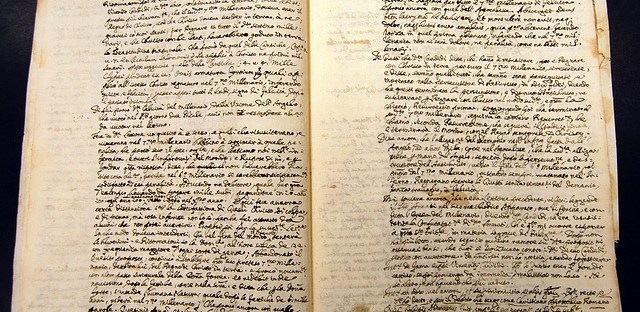
In this blog, we will be looking at how to reference books in OSCOLA – but not just any old books! In fact, we will be considering particularly old books, such as those that were published before 1800. We will discuss why there is a different referencing method for this sort of book and why you can’t just reference older works in the same way as you would a normal book. We will also consider what the benefit of referencing older works is and when it will strengthen your work, as well when you might not want to use them as a source.
We will start by examining all of these points, then move on to the referencing. As always, if you already know the background, do feel free to skip ahead to the part on citations below!
Why are Older Works Referenced in a Different Way to Books?
First of all, what is different about books that were published before 1800? Well, if you look at one (or a copy or electronic version of one) and turn to the page that would usually have details of publication, you may find it curiously empty! This is because books published before 1800 rarely have a publisher given, instead simply having a list of booksellers that stocked them. As these lists can be very long, you probably don’t want to be copying them all out into your references, any more than readers will want to have them there!
You may instead be able to find a date and place of publication, which you can use in the reference in place of the actual publisher. The aim of this is to still allow your readers to be able to find the book if they would like to read it themselves, which ties up with the OSCOLA golden rule to be considerate to the reader. The more accurate information you supply, the easier it is for them to find out more or check a particular fact if they want to. In this way, it is simpler for the reader to follow your argument or any points you have made.
When Should You Reference Older Works?
Older works can be a very strong reference for your legal writing, but you should evaluate them in the same way as you would any other source. This means considering a number of different points concerning them and deciding on the basis of this whether they can be used as a reliable source.
One of the points to consider when you are evaluating a source is the currency of it i.e. how recent is it? Obviously, older works are never going to be recent, but this is not necessarily a problem – it will depend on what you are writing. It is good to have at least some recent sources, but they don’t all need to be. If you are looking at the historical context of law, for example, it makes sense that you would have older works from the time you are discussing.
This links to one of the advantages of using older works as a source when you are writing about historical cases or events. They give a picture of what the law was like at the time, unlike a textbook written many years later. In this way, older works offer a snapshot into the history of how legislation or cases were considered at the time and how this created new law. Some older works can, in fact, be considered a primary source if they offer views on cases from history, although it is important that you remember that they are opinions rather than facts.
This leads to another point in determining source reliability – what is its purpose? Was it written purely to inform, just giving the facts and nothing else, or was it written with the aim of persuading the reader of a particular point of view? Sources that just list the facts with no sort of opinion or analysis offered may well be reliable for learning and referencing the events, although do check that they are correct, if possible.
However, a source that is writing to persuade is less reliable as it may focus on certain points and miss out others. It may also be unclear what is factual and what is more based on the author’s opinion of events.
How Do You Reference Older Books?
The basic format is the same as for regular books, that is:
Author, | Title of book | (Additional information, Edition, | Publisher | Year)
For example:
Gareth Jones, Goff and Jones: The Law of Restitution (1st supp, 7th edn, Sweet & Maxwell 2009).
However, as stated above, it can be difficult to get all of this information for older books, so a slightly different format may be needed.
If the book just has a list of booksellers instead of a publisher, you can simply give the date and place of publication in the reference.
If you need to cite a more recent publication of an older work, you can also cite the original date of publication inside the brackets, before the publication details of the newer version and followed by a comma. For example:
Thomas Hobbes, Leviathan (first published 1651, Penguin 1985).
Pinpointing is done in the same way as for any book – the first page number is written after the closing bracket, but before the full stop (which is only there if the citation is in a footnote). For example:
Thomas Hobbes, Leviathan (first published 1651, Penguin 1985) 268.
Wrapping Up
I hope that you now know more about older works and how to cite them in OSCOLA. Next time we will be looking at how to reference books of authority and institutional works, so stop by in two weeks if you want to read that!
Want help proofreading your work? Contact Carmine Proofreading for a friendly, professional service from a qualified proofreader.
Email: CarmineProofreading@gmail.com
Twitter: https://twitter.com/CarmineProofed

 Carmine Proofreading