

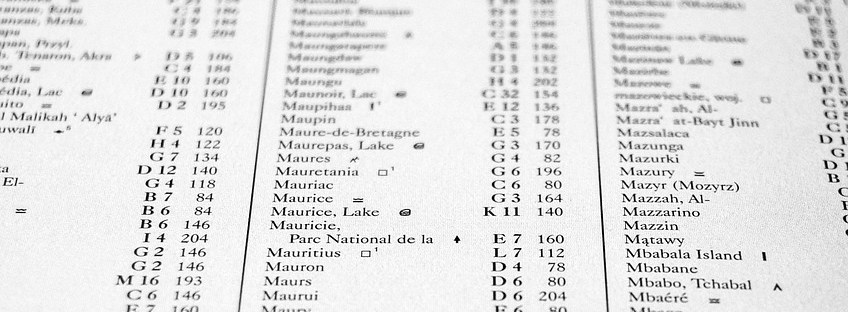
In this week’s blog post, we will be looking at creating an index for your self-published nonfiction book. We will start by looking at why indexing is so important and how it helps your readers, then consider some of the most common terms that you might come across when starting to build an index. We will also look at the possibility of hiring a professional indexer to do the job and what the benefits of this are.
First of all, what is an index? An index lists all of the major subjects that are discussed in your work and gives the page number where readers will find them. Essentially, it is there to help your readers use your book and allow them to easily find the information they need. It acts as a sort of map to your book, letting your readers instantly find all mentions of a particular topic and expand their research by looking at “see also” options.
Why Do You Need an Index?
An index is important for the reasons mentioned above – it helps your readers and acts as a map for easy research. However, there is a bit more to it than this. An index also adds value to your book just by making it navigable. Imagine you are comparing two similar books on a particular topic, but one has an index while the other doesn’t. Chances are you will buy the one that has the index because it is more reader-friendly and helps with exploring topics further.
It is also worth noting that nonfiction books usually have an index and readers will expect this. Check within your specific niche, but not having an index may well make your book stand out for all the wrong reasons.
Indexing Terms
Headings
Headings are the words and phrases used in the index to identify particular subjects and names. They will be in alphabetical order and may have sub-headings under them to divide up categories. Sub-headings are usually slightly indented under the main heading to distinguish them and will also be in alphabetical order.
Locators
The page numbers listed after the headings in an index are called locators.
Cross-Reference
Sometimes, looking up a term in your index might redirect your readers to another heading. This is called cross-referencing and helps to keep your index efficient. It essentially means that the term your readers originally looked for has either been grouped under a wider term or simply swapped for a more common name. For example, you might have “Calves. See cows”. Alternatively, there might be a “see also” reference, which swaps the term with specific ones which are more common in your book. For example, you could have “Dairy. See also cheese; butter”.
Double-Posting
On the other hand, there are sometimes multiple, equally valid, terms. In this case, you would want to have them both included in the index, with all the locators at each one. For example, you might want to have separate headings for tiger and Panthera tigris.
Why Use a Professional?
You can see from this how important the job of the indexer is. It is not simply a case of selecting relevant terms, then writing the correct page numbers by them; they also have to guess what terms your readers might use to find the information. They then have to decide whether any cross-references are necessary and, if so, what terms will link to which.
It is possible to do this for your own book, but it is difficult to do so. For a start, you may be too familiar with it! It is easy to find any given point or section in your book, as you wrote it and know it inside out. However, it is less easy for you to do this from a new reader’s perspective, as they will be unfamiliar with your book and may well choose different terms to look for.
Professional indexers will be a lot more experienced and should have the training to pick out the best headings to include in the index. They will also be able to think of other ways that people might search for things, leading to the double-posting method mentioned above. An indexer will also have experience handling cross-references to make sure the index is accurate and stays relevant to the content of your book.
Where to Find an Indexer
So, where should you start looking for a professional indexer for your book? This will depend on which country you are in, but there should be a national society that you can find. Check what sort of training and experience they require their members to have and then have a look through their directory. For example, in the United Kingdom and Ireland, there is the Society of Indexers.
Wrapping Up
I hope that you now feel more confident about whether you need an index and how to find a reliable, professional indexer. In my next blog post, we will be looking at how to create a nonfiction audiobook by hiring a narrator, so come back in two weeks for that!
Want help proofreading your work? Contact armine Proofreading for a friendly, professional service from a qualified proofreader.
Email: CarmineProofreading@gmail.com
Twitter: https://twitter.com/CarmineProofed

 Carmine Proofreading