

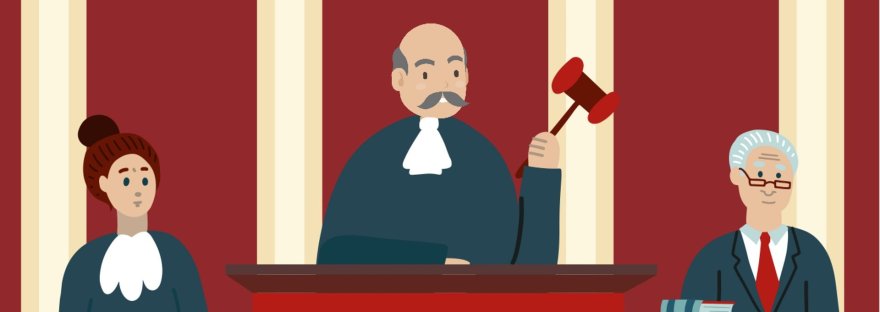
In this week’s blog post, we will be looking at how jurors are selected at the trial. This follows on from my last blog post about the pre-trial selection process and focuses on how jurors are selected once they are at court. We will also briefly review the role of the jury in the UK and why they are used in certain trials. Juries are a vital part of the justice system, so it is important to bear their role and purpose in mind when answering questions about them.
Role of the Jury
The jury is made up of 12 peers of the defendant, randomly selected from the population to try to ensure that their final decision is unbiased. The primary role of the jury is to decide whether the defendant in the case should be found guilty or not guilty of the charges against them. They will do this based only on the facts of the case, meaning that they cannot be following media coverage of the trial which might influence their verdict.
If delivering a guilty verdict in a criminal case, the jury must be satisfied that this is “beyond all reasonable doubt”, to avoid unjust results. When delivering a verdict in a civil case, the jury need only be sure “on the balance of the probabilities”, a much lower burden of proof. This is to allow for the fact that an incorrect outcome in a civil case is likely to be less damaging than one in a criminal case, where there is, for example, a possibility of imprisonment.
There will be someone at the court to explain how the trial will be conducted to the jury, helping them to understand the proceedings. They will also be advised on legal matters by a court official, such as what the requirements are to prove someone guilty of a particular crime and any precedents that would indicate the typical outcome. However, juries are not bound to follow this advice; instead, they can come to a decision based on what they think is fair. It is important to remember that juries only give a guilty or not guilty verdict, the sentence passed down in a guilty verdict will be decided by the judge.
Selecting the Jury
All of the jurors selected will be added to a panel list. All the parties to a jury case can review this and make enquiries about any of the people on it, which may lead to further checks. In addition, all jurors will be subject to a Disclosure and Barring Service (DBS) check to ensure they are not disqualified from jury service. Occasionally, more detailed tests will be needed, such as in cases that involve national security. The Attorney General will have to give permission for these tests, which may include DBS checks, Special Branch records checks and Security Services checks.
15 jurors will be chosen at first, from which the court clerk will select 12 at random. The chosen jurors must say if they know any of the parties to the case. If so, the judge will decide based on the information given whether to ask the jury member to stand down or to allow them to continue. If they do have to stand down, they will be replaced by one of the three remaining jurors.
Jurors may also be asked by the prosecution to stand by, but only in specific circumstances. One of these is if they consider the jurors to be unfit for duty in some way, such as them being illiterate in a case that has written evidence. The defence will have to agree for this to take effect. Another reason for asking a juror to stand by is if it is a national security case and the Attorney General has authorised additional checks. This must be done with the permission of the Attorney General and there must be good reasons to think that the jurors might be a security risk, susceptible to improper approaches, or likely to be influenced in their decision.
Challenges for cause can be made by the defence or prosecution and may be a challenge to the array (meaning all of the jurors) or to the polls (meaning one specific juror). Although challenges to the array can technically still be made under the Juries Act 1974, it is now extremely rare to see it used.
Challenges to the polls are more common and can be used where it is felt that the jurors in question might be biased. For example, if the juror has previously been hostile or has links to one party this could cause bias in their decision. This challenge must be made before jurors are sworn in and the burden of proof is on the party making the challenge.
Finally, the judge can use their discretionary power to remove a juror that they believe is unfit to serve. For example, if they see signs that a juror is illiterate but neither the defence nor the prosecution challenge this, the judge is within their rights to have this juror removed.
Wrapping Up
I hope that this helps you to understand jury selection in the UK. In my next blog post, we will be asking when juries are used, so come back in two weeks for that!
Want help proofreading your work? Contact Carmine Proofreading for a friendly, professional service from a qualified proofreader.
Email: CarmineProofreading@gmail.com
Twitter: https://twitter.com/CarmineProofed

 Carmine Proofreading